
A conversation about love
It was Valentine's day and we started talking about love again... with Melissa

I'm currently a master's student in the Cheriton School of Computer Science at the University of Waterloo. My goal is to disrupt systemic harm by investigating the technologies that enable it and designing new tools to support those working towards safer, softer, and more just futures. I’m currently researching the effects of AI (il)literacy on participatory research methods under the supervision of Dr. Dan Brown and Dr. Maura Grossman. My thesis seeks to ensure the validity of existing and future participatory research in HCI for mental health as well as the broader field. I also work with AI4Abolition, led by Dr. Avriel Epps, on creating a platform to enable the work of transformative justice practitioners. I am fortunate and immensely grateful to be working with and surrounded by brilliant, kind, and supportive people. Scroll down to see some of my work (and keep scrolling for non-work stuff!)
Please see my CV for a comprehensive list of publications, talks, awards, etc.
Here are some projects I've worked on recently. Click on each title to read more about the project and see any papers/posters/artifacts about it! If any of this interests you, feel free to reach out.
How is AI changing the landscape of mental health care?
How can we ensure the validity of participatory research methods in HCI for mental health in the current AI age? HCI research often overlooks the gap between the actual tech- and AI- literacy of participants and that assumed by experimental designs. This assumption risks the validity of research findings, as results predicated on participants’ faulty conceptions of what AI is may not reflect the reality of the problem being investigated. My thesis investigates the effects of AI (il)literacy on participatory research methods through a mixed-methods study in the form of a series of semistructured interviews with mental health practitioners that evaluate if and how their perceptions towards mental health change pre and post educational intervention. I aim to quantify this gap with established survey tools and support the findings with qualitative interview data.
This is an ongoing project!
Given that LLMs have demonstrated significant biases (eg. racism, sexism, heteronormativity, etc.), what harm might arise when they meet with the historically biased field of mental health? This project aimed to evaluate diagnostic prejudices in LLMs based on intersecting identities presented in patient profiles. I conducted a pilot study and presented initial results as a poster at KDD 2025. I also wrote an essay exploring the risks and potentials of LLMs in mental health care, which was published recently.
Wang, C., Grossman, M., & Brown, D. (2025). Measuring LLM Bias in Mental Health. ACM Conference on Knowledge Discovery and Data Mining. Toronto, Ontario, Canada, August 5, 2025. Poster presentation.
Wang, C. (2025). The Risks and Potential of Large Language Models in Mental Healthcare: A Critical Analysis through the Lens of Data Feminism.(Un)Disturbed: A Journal of Feminist Voices, 2 (2): 41-52.
What possibilities exist at the intersection of transformative justice (TJ) and AI?
Transformative justice is an alternative approach to creating community safety that does not depend on the harmful carceral norms of policing. TJ processes, which address harm when it occurs, are community-based and rooted in accountability, with the goal of collective sensemaking in order to move towards shared understanding, repair, and healing. Importantly, it also seeks to transform the conditions that facilitated the harm to ensure that it is less likely, or impossible, for it to occur in the future. To learn more, Partisse Cullors wrote this great piece for the Harvard Law Review. If you'd like more book recommendations I'm happy to share! You can find my email at the bottom of this website.
REPaiR is a platform we are developing to support the work of transformative justice practitioners. Based on a participatory design process, we are exploring practitioners' current attitudes towards and uses of technology, identifying ways that technology can support their practises, working to establish safety guardrails, and designing a trauma-informed platform based on the community's positionality.
This is an ongoing project!
Ferrari, T., Epps, A., Ames, R., Wang, C. (2025). Participatory AI Research and Development to Support Transformative Approaches to Justice and Community Safety. ACM Collective Intelligence Conference, La Jolla, California, USA, August 4-6, 2025. Poster presentation.
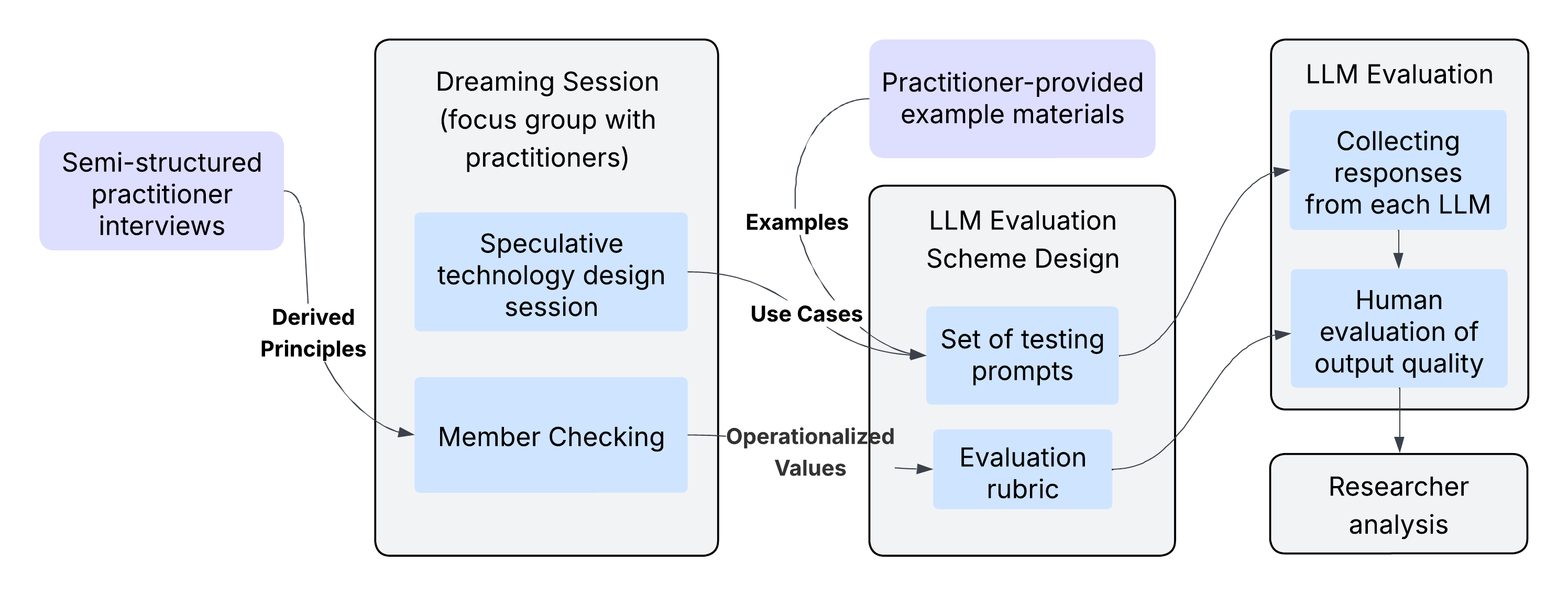
This project aimed to understand the varying degrees of alignment between foundational LLMs and the values held by transformative justice practitioners, in order to make informed decisions about whether and how LLMs can be implemented in this context. I led the development of an evaluation protocol rooted in community values (as identified by part of our research process for REPaiR) in order to assess this alignment.
Wang, C., Epps, A., Ferrari, T., Ames, R. (2025). AI for Abolition? A Participatory Design Approach. In Proceedings of the Workshops at the Fourth International Conference on Hybrid Human-Artificial Intelligence. (Selected for oral presentation)
 Speculative fiction for tech-driven menstrual equity completed as a final project for a graduate seminar course on HCI along with two other students. Through a series of design exercises analyzing a speculative technology through various value-oriented lenses, we created a set of fictional artifacts exploring how this technology could support (or hinder) menstrual justice.
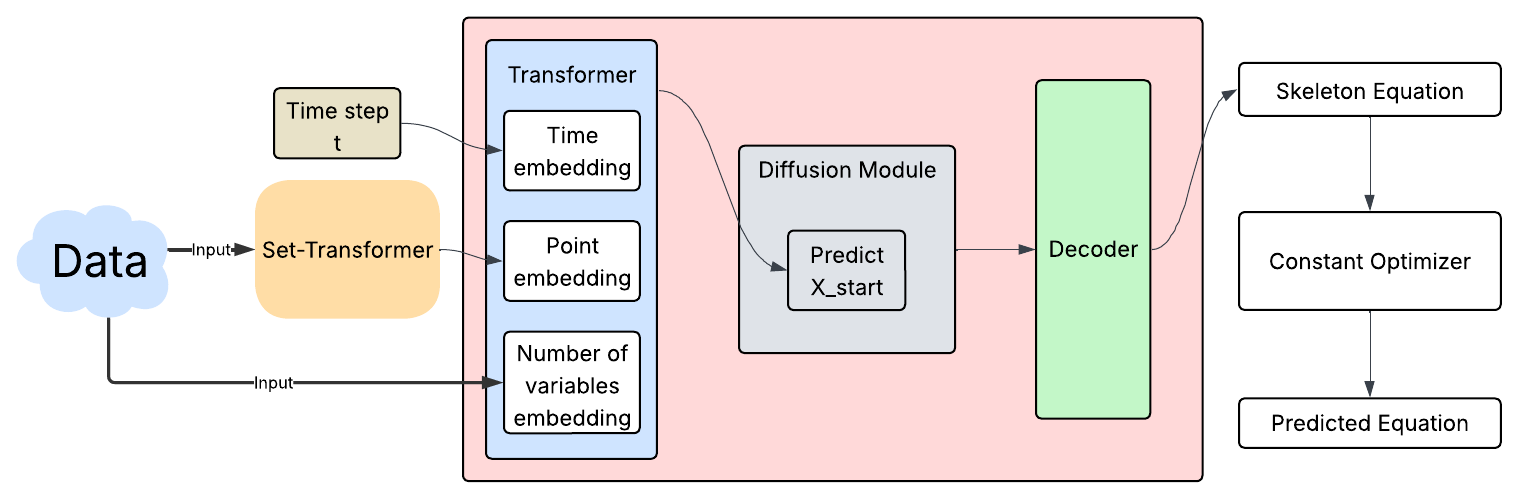
This was a final project from a graduate seminar course on generative AI and LLMs that I completed with two other students. We developed a novel-diffusion-based model architecture, inspired by discrete-diffusion models for text data, to perform symbolic regression and benchmarked it against an existing deep learning approach.
I worked on a project to improve upon prior sex-specific kidney function models which enable researchers to understand risk factors for kidney injury, accounting for the historically overlooked biological differences between sexes. My work contributed to a publication in Mathematical Biosciences.
Leete, J., Wang, C., Lopez-Hernandez, F. J., & Layton, A. T. (2022). Determining risk factors for triple whammy acute kidney injury. Mathematical Biosciences, 347, 108809.
It was Valentine's day and we started talking about love again... with Melissa

Melissa and I got nostalgic.

I discovered Adobe Rush and developed a hyperfixation for a bit...

Feeling a bit sensitive about this right now, but may be willing to share privately. Email me if you're interested in reading some manic musings on life/love/nostalgia/etc.
I'm a huge fan of Paradis and Tame Impala, I enjoy cooking, and (someday) I want to buy the Ikon Pass and spend 6 months skiing around the world. I try to do yoga regularly and have recently started weight training! Gyms are an excellent third space. I also love reading, farmers markets, and planning trips & events with my friends (email me if you want travel plans for Guatemala, Vancouver, New York, a cottage weekend, Portugal, or Albania!)
I love meeting new people, please reach out if any of my work is interesting/you want book recommendations/you want travel plans. My email is carolyn.wang@uwaterloo.ca